Address
Al Quoz Industrial 1, Dubai
052 - 2994540
Work Hours
Monday to Friday: 9AM - 6PM
Weekend: 12AM - 5PM
Address
Al Quoz Industrial 1, Dubai
052 - 2994540
Work Hours
Monday to Friday: 9AM - 6PM
Weekend: 12AM - 5PM

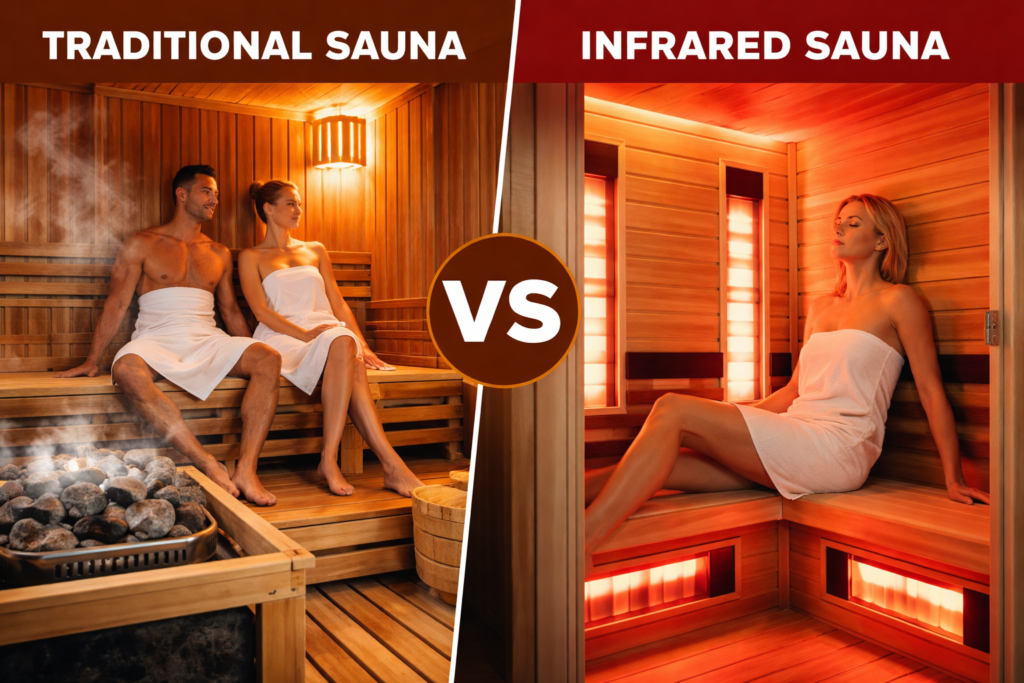
If you are considering buying a sauna for your home in Dubai or Abu Dhabi, the first decision you will face is choosing between an infrared sauna and a traditional sauna. Both offer excellent health benefits and a relaxing experience, but they work in fundamentally different ways
This guide breaks down every important difference — how they heat, what they cost, how they feel, their health benefits, electricity consumption in the UAE, and which one makes the most sense for your space, budget, and lifestyle.
How Does Each Sauna Type Work?
Infrared Sauna — Direct Body Heating
An infrared sauna uses carbon or ceramic heating panels that emit far-infrared light waves. These invisible waves penetrate your skin by 1.5 to 2 inches and warm your body directly from the inside out, without heating the air around you significantly.
Think of it like standing in sunlight on a cool day — you feel warm even though the air temperature is not high. This is the same principle infrared saunas use, minus the harmful UV rays.
Because infrared saunas heat your body directly rather than the surrounding air, they operate at much lower temperatures while still producing a deep, satisfying sweat.
→ Browse Valluxy's infrared sauna collection: https://valluxy.com/product/infrared-sauna/
Traditional Sauna — Heating the Air
A traditional sauna, also known as a Finnish sauna, uses an electric heater loaded with volcanic stones to heat the air inside a wooden cabin. The air temperature rises to between 70°C and 100°C. You can pour water over the hot stones to create bursts of steam, which increases humidity and intensifies the heat sensation.
This is the classic sauna experience that has been practiced in Finland for over 2,000 years. The combination of extreme dry heat and optional steam creates an enveloping warmth that promotes heavy sweating and deep relaxation.
→ Browse Valluxy's traditional sauna collection: https://valluxy.com/product/traditional-sauna/
Side-by-Side Comparison
FEATURE | INFRARED SAUNA | TRADITIONAL SAUNA
Heating Method | Infrared light heats body | Hot stones heat the air
Temperature Range | 45–65°C | 70–100°C
Heat-Up Time | 10–15 minutes | 30–45 minutes
Session Duration | 30–45 minutes | 15–20 minutes
Steam Option | No | Yes (water on stones)
Electricity (per session) | 1.5–2 kWh | 4.5–9 kWh
Cost Per Session (DEWA) | AED 1–2 | AED 3–5
Power Requirement | Standard 13A outlet | Dedicated 32A circuit
Installation Complexity | Plug-and-play | Requires electrician
Space Needed (2-person) | ~1.2m × 1.0m | ~1.5m × 1.2m
Best For | Pain relief, detox, daily use| Intense heat, steam, social
Starting Price (Dubai) | From AED 8,000 | From AED 15,0
oth infrared and traditional saunas deliver genuine, research-backed health benefits when used regularly. Regardless of which type you choose, consistent sauna use supports improved cardiovascular health and blood circulation, stress reduction and better mental clarity, muscle recovery and relief from soreness, improved sleep quality, detoxification through sweating, and a stronger immune response.
A well-known long-term Finnish study following over 2,000 men for more than 20 years found that frequent sauna use was associated with significantly lower risk of cardiovascular events. While this study focused on traditional saunas, researchers believe the core mechanism — repeated heat exposure and cardiovascular response — applies to both types
Where Infrared Sauna Excels
Infrared saunas have a growing body of research supporting their effectiveness for specific therapeutic applications. Because infrared energy penetrates deeper into tissue at lower temperatures, infrared saunas tend to be more effective for chronic pain management, particularly conditions like arthritis, fibromyalgia, and joint stiffness. The deeper tissue penetration promotes better post-workout muscle recovery compared to passive rest. Research has shown improvements in chronic fatigue symptoms with regular infrared sessions. The lower temperature makes infrared saunas more comfortable for people who do not tolerate extreme heat well, including older adults. The longer session time (30-45 minutes vs 15-20 minutes) means more total heat exposure per session, which can amplify therapeutic benefits
Where Traditional Sauna Excels
Traditional saunas have the advantage of decades more research and a wider range of documented benefits. The higher temperatures create more intense cardiovascular stimulation, similar to moderate exercise. The steam option (pouring water on stones) helps clear airways and may reduce the frequency of common respiratory infections. The hot-cold cycling practice — alternating sauna sessions with cold water immersion — has additional benefits for inflammation reduction, immune function, and mental resilience. Traditional saunas promote more intense sweating, which can enhance the detoxification effect. The higher temperatures trigger greater release of growth hormone and heat shock proteins, which support cellular repair and longevity. The social aspect is stronger — traditional saunas are typically larger and designed for shared experiences.
→ Pair your traditional sauna with a Valluxy Cold Tub for the ultimate hot-cold contrast therapy: https://valluxy.com/product/valluxy-cold-tubs/
lectricity and Running Costs in Dubai
Understanding the electricity cost is important for UAE homeowners, where DEWA rates apply. Here is a realistic breakdown of what each sauna type costs to run.
An infrared sauna draws between 1,500W and 2,000W. A typical 30-minute session uses about 1–1.5 kWh of electricity. At current DEWA slab rates, this costs roughly AED 1 to AED 2 per session. If you use it five times a week, your monthly electricity cost for the sauna is approximately AED 20 to AED 40.
A traditional sauna heater ranges from 4,500W to 9,000W. A 30-minute session (excluding preheat time) uses about 4–6 kWh. Including the 30-45 minute preheat, total consumption can reach 6–9 kWh per session, costing AED 3 to AED 5. Monthly cost for five sessions per week is approximately AED 60 to AED 100.
While traditional saunas cost more to run, the difference is modest in the context of overall home utility bills. Most homeowners find the monthly sauna electricity cost is less than a single spa visit
Installation in Dubai — What Each Type Requires
Infrared saunas are the easiest to install in a Dubai home. Most models are plug-and-play, meaning they come as prefabricated cabin panels that you assemble together (usually in 1-2 hours) and plug into a standard 13A household socket. No electrician is needed, no DEWA approvals required for plug-and-play models, and no plumbing or water connections involved. They fit in a spare room, master bathroom, walk-in closet, garage, or balcony. This simplicity makes infrared saunas ideal for apartments and townhouses where major electrical work is not practical
Traditional saunas require more planning. The electric heater (typically 4.5kW to 9kW) needs a dedicated 32A electrical circuit installed by a licensed UAE electrician. DEWA approval may be required for the new circuit in Dubai, or ADDC approval in Abu Dhabi. Proper ventilation must be installed — an air intake vent near the heater and an exhaust vent for air circulation. The cabin itself is assembled from prefabricated panels or custom-built on site. Installation typically takes 3 to 7 days including electrical preparation, cabin assembly, heater mounting, and testing
For villa communities managed by Emaar, DAMAC, or Nakheel, a No Objection Certificate may be required before installation. Valluxy's team handles all coordination and approvals as part of the installation service.
→ Need a custom installation? Explore Valluxy's custom-built saunas: https://valluxy.com/customized-sauna/
Which Sauna Is Best for Dubai Homes?
The right choice depends on your priorities, space, and how you plan to use it. Here is a quick decision guide.
Choose an infrared sauna if you want a plug-and-play solution with minimal installation hassle, you live in an apartment or townhouse with limited space, you prefer lower temperatures and longer, gentler sessions, your primary goals are pain relief, muscle recovery, or daily detox, you want the lowest electricity consumption, or your budget is under AED 20,000.
Choose a traditional sauna if you want the authentic Finnish sauna experience with steam, you have a villa with space for a dedicated sauna room, you enjoy high-intensity heat and shorter sessions, you plan to combine sauna with cold plunging for contrast therapy, you want the social experience of sharing the sauna with family or guests, or your budget allows for AED 15,000 to AED 50,000+ including installation.
Consider a hybrid sauna if you cannot decide between the two. Some models combine both infrared panels and a traditional stone heater in one cabin, letting you switch between modes depending on your mood. This gives you the best of both worlds.
→ Check out Valluxy's Hybrid Sauna (Infrared + Stones): https://valluxy.com/product/hybrid-sauna/
Maintenance Comparison
Both sauna types are low-maintenance when cared for properly, which is especially important in Dubai's climate where humidity differences between your air-conditioned home and the sauna interior can stress the wood over time.
For infrared saunas, wipe down benches and walls after each session, vacuum the floor monthly, check the heating panels and electrical connections once a year, and leave the door open for 15 minutes after each session to let moisture escape. No special maintenance is needed for the heaters.
For traditional saunas, follow the same bench wiping and floor cleaning routine. Additionally, clean the sauna stones every 6 months by rinsing them with water to remove mineral buildup, and replace the stones every 1 to 2 years as they deteriorate from repeated heating and cooling. Check the heater elements annually, and if you use the steam function frequently, monitor the wood near the heater for any signs of excessive moisture damage.
With proper care, both types of saunas last 15 to 20 years or more, even in Dubai’s climate.
Final Verdict
here is no universally "better" sauna — the right choice depends entirely on your personal needs. If you want convenience, lower running costs, and therapeutic heat at comfortable temperatures, infrared is excellent. If you want the full-body intensity of traditional steam sauna with decades of proven health research behind it, traditional is the way to go.
The most important thing is that you use it consistently. The health benefits of sauna use compound over time with regular sessions, so the best sauna is ultimately the one you will actually use three to five times per week.
Valluxy offers both infrared and traditional saunas crafted from high-quality Canadian Hemlock wood, with professional installation and a minimum 1-year warranty across Dubai and Abu Dhabi.
→ Browse our full collection: https://valluxy.com/shop/
→ Visit our showroom: Al Quoz Industrial 1, Dubai
→ Call us: +971-52-299-4540
→ Read our complete buying guide: https://valluxy.com/2026/04/20/how-to-buy-a-sauna-in-dubai-the-complete-guide-for-uae-homeowners-2026/
Infrared sauna vs traditional sauna — your questions answered
Not sure which sauna type is right for you? Our experts can help you decide.
Get Free Consultation